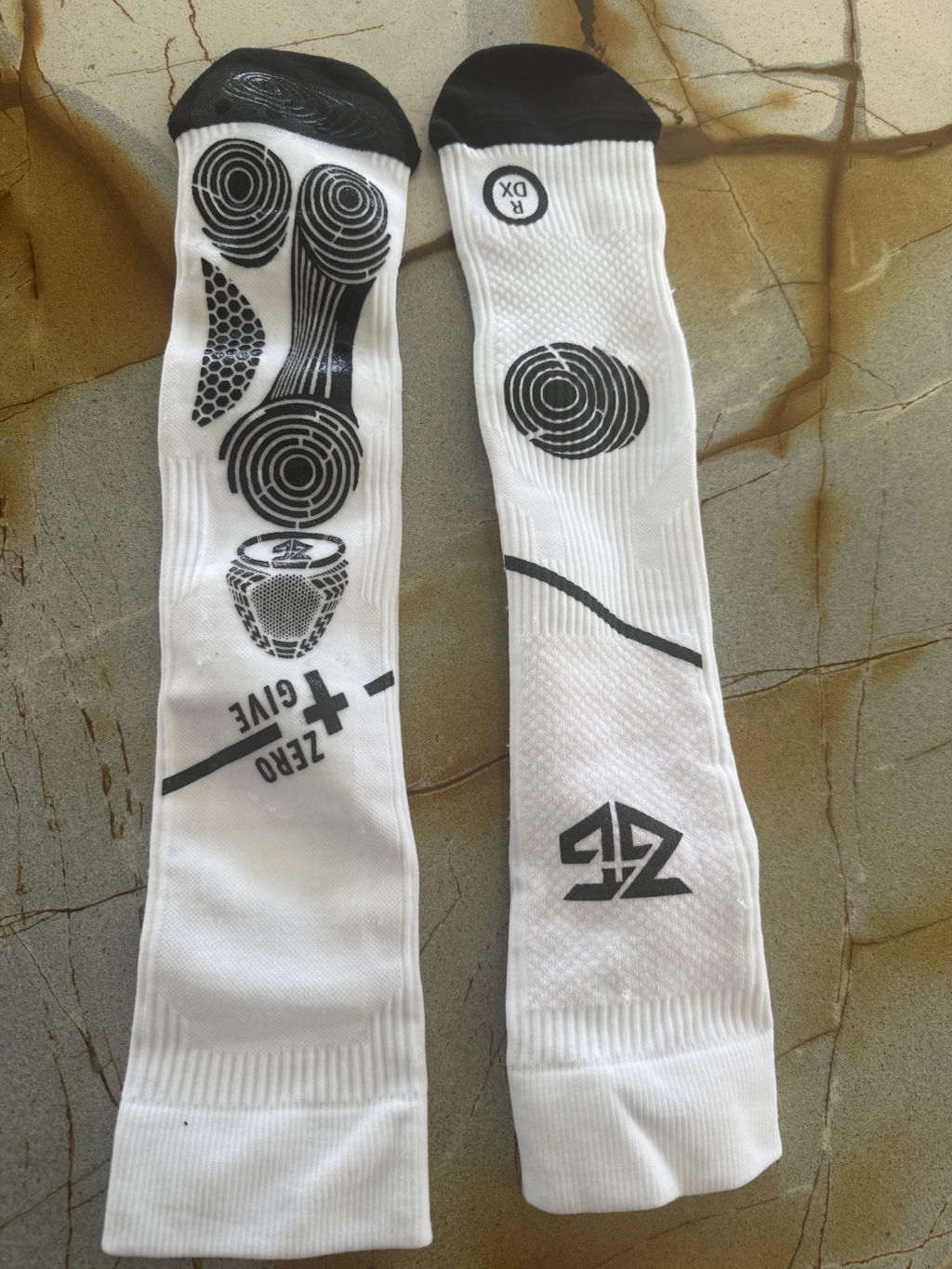
Ultra-Lightweight Construction
58 g per pair in Zero Give's 2026 internal product-sample measurements, built to minimize bulk inside the cleat.


ZERO GIVE® SIZE GUIDE
Use your normal shoe size, then choose S, M, or L from the size selector.
| SELECT | ZERO GIVE® FIT | MEN'S US | WOMEN'S US | EU |
|---|---|---|---|---|
| S | XS/S | 4–7 | 5–8 | 36–40 |
| M | M/L | 7.5–10.5 | 8.5–11.5 | 40.5–45 |
| L | L/XL | 11–14 | 12–15 | 45.5–49 |
Performance fit: Zero Give® grip socks are designed to fit snugly and securely inside soccer cleats without bunching.
Cleat size (optional)
Optional: include the sizing system—for example, US 9, UK 8, or EU 42.5. We can use this to help confirm your ZERO GIVE fit.
Zero Give® is a lightweight soccer grip sock engineered for a close, stable connection between the foot, sock and cleat. Patent-pending PivotCore™ Technology combines strategic external plantar traction with anatomical right/left construction, technical fibers and 12–20 mmHg graduated compression.
PivotCore™ places traction across key plantar contact areas rather than relying on a bulky all-over grip layer. The goal is a secure, low-bulk interface inside the cleat while preserving natural foot movement. The external grip works at the sock-to-insole interface; the cleat studs remain responsible for traction against the playing surface.
PivotCore™ combines targeted underfoot grip, anatomical right/left alignment and a secure compression knit to help reduce unwanted movement inside the cleat. By keeping the heel seated and the sock aligned through the foot and ankle, the system supports a more stable path for force as the player accelerates, cuts and pushes off. It is designed for fit and performance support—not to treat or prevent Achilles injuries.

In Zero Give's 2026 internal product-sample measurements, a pair of Zero Give socks weighed 58 g. Full flattened-sock thickness measured 3.37 mm at the toe and 4.40 mm at the cuff. Weight and thickness are different measurements, and neither alone determines comfort or match performance. Players should choose a sock that works with the internal volume and shape of their cleats.
73% Nylon / 20% LYCRA® / 7% COOLMAX® — 0% cotton. Nylon provides a lightweight technical base, LYCRA® supports stretch and shape retention, and COOLMAX® is used for moisture management inside a warm soccer boot.
Dedicated right and left socks are shaped to follow the geometry of each foot so the heel, arch and forefoot zones stay aligned. A secure fit should sit flat without twisting, excess toe fabric or bunching under the arch.
The compression knit is designed to maintain a close, consistent fit through training and match play. Compression is part of the sock's fit architecture; Zero Give does not claim that the sock treats or prevents injury or medical conditions.
Your ankle is the link between your foot and lower leg, and it works hard every time you sprint, cut, stop, push off, or change direction.
12–20 mmHg graduated compression is designed to give the ankle and lower leg a snug, locked-in feel without restricting normal movement. That close fit may also improve proprioceptive feedback—your awareness of where your ankle is and how it is moving.
Graduated compression may also support circulation by helping blood move back up the lower leg and may help reduce temporary swelling or that heavy-leg feeling during or after hard sessions.
For athletes, the goal is simple: a more secure, supported feel through the ankle and lower leg while you move. Zero Give does not claim that compression prevents or treats injuries or medical conditions.
Zero Give publishes its internal product testing rather than relying only on marketing claims. In the 2026 British Pendulum comparison, Zero Give recorded a mean result of 75 BPN across four repeated tests. BPN is a test-specific pendulum reading and is not coefficient of friction or a direct measurement of soccer performance.
See the full friction test methodology and results.
Zero Give also publishes direct weight and caliper measurements so players can compare how much material different grip socks may add inside a cleat.
See the full weight and thickness case study.
Choose the size that keeps the heel seated and the fabric smooth across the arch and forefoot without excessive compression or loose material. Test the socks in the exact cleats you use for soccer. After the boots warm up, check for heel movement, forefoot sliding, bunching or pressure points.
Grip socks cannot correct a cleat that is too large, too narrow or the wrong shape. Start with a properly fitting boot, then use the sock to refine the internal connection. Players in very low-volume speed boots may prefer a thinner sock, while roomier boots may tolerate more material.

ZERO GIVE® is designed to work with performance cleats including Mercurial Vapor, F50, Phantom, Predator, Mercurial Superfly, Tiempo, Future, and Copa Pure. Fit still varies by cleat volume and foot shape.

See the soccer cleat heat-transfer and COOLMAX® placement case study.
Wash cold and air dry. Avoid high heat, bleach and fabric softener. Keep the socks away from exposed hook-and-loop fasteners that can snag technical fibers.
For side-by-side measured product data, visit the Soccer Grip Socks Comparison. Testing shown on ZeroGive.com is internal product-sample testing under stated conditions and is not independent laboratory certification.
For a direct comparison, compare ZERO GIVE® with TRUsox 3.0.
Compare the 2026 soccer grip sock test rankings and wet/dry traction results.
See Zero Give in action.
WHY IT'S DIFFERENT
58 g per pair in Zero Give's 2026 internal product-sample measurements, built to minimize bulk inside the cleat.

Five external grip zones place traction across key plantar contact areas without a heavy all-over grip layer.

Targeted structure around the heel and Achilles helps keep the sock seated and aligned during play.

Dedicated right and left construction keeps the heel, arch and forefoot zones aligned with each foot.

73% nylon, 20% LYCRA®, 7% COOLMAX® and 0% cotton for a lightweight, moisture-managing build.

A compression-knit upper keeps the fit close and consistent through training and match play.
1 / 6
Best grip socks of all time, makes me become the best I could be, no slipping and my feet are breathable.
thank you
grip socks feel lightweight and secure in my cleats. The grip helps keep my foot from sliding around, and the compression gives a locked-in feel without bulky cushioning. I also like the below-calf design and breathable feel. A great option for players who want dependable grip without extra bulk.
These are honestly the best grip socks I’ve used and I’ve tried a lot. The compression feels really good and the grip is actually unreal even when my feet get sweaty. My feet don’t slide around in my cleats and they feel really secure when I’m cutting or running. Definitely recommend these
Fits amazing with the compressing feel, I like the design. The grip also felt great
These have become my FAVORITE GRIP socks for soccer. They’re lightweight, stay securely in place, and don’t slide around inside my cleats when I’m sprinting, cutting, or changing direction. The grip is like nothing I’ve ever experienced, and the compression feels snug and amazing without being uncomfortable. They provide great support throughout the game. Definitely recommend them for any soccer player!
The best grip socks I ever used, feet are locked in, snug fit and very breathable. These socks are in a league of its own. BEST GRIP SOCKS EVER.
Best socks ever. ZERO GIVE feels lightweight, secure, and locked in inside the cleat. Love the compression! Excellent fit, great grip, and comfortable even through a full session. Easily my favorite soccer grip socks.
The fit is tighter than a normal soccer sock, which I ended up liking. My foot and ankle felt supported and the grip did its job.
Thanks. The close compression fit is intentional for a secure performance feel.
Tried them in practice first and then wore them in a game. No bunching, no sliding, and they stayed comfortable through the second half.
Thanks for testing them in both training and match play.
Hard to explain but my foot feels more connected to the cleat. I especially notice it when planting before a pass or shot.
That connected feeling is exactly what the sock is intended to create.
I have used them three times so far and they still feel the same. Good grip, good compression and not too hot during training.
Appreciate the feedback on grip, compression, and training comfort.
My favorite part is how secure the heel feels. During sprints and stops I did not get the little bit of movement I usually notice.
Thanks. Heel control is a major part of the lockdown design.
I use a pretty fitted cleat and these did not add much thickness. I still got strong grip without making the boot feel cramped.
Great to hear they worked well in a close-fitting boot.
The ankle and foot compression is noticeable, especially when you first put them on. Once playing, they just feel supportive and locked in.
Exactly. The compression is designed to feel snug while playing.
Wore them for a full 90 minutes and never had to adjust them. The sock stayed put and my heel felt more stable than with normal crew socks.
Thanks for the detailed feedback on fit and heel stability.
I expected grip socks to feel thick but these are pretty light. The grip is strong and they worked well in my speed boots.
Glad the lightweight feel worked well with your boots.
The biggest difference for me was on fast direction changes. I did not feel my foot sliding forward or sideways inside the boot.
That controlled feel during cuts is what we designed the grip pattern for.
At first they felt tighter than my regular socks, but after warming up I liked the compression. My cleats felt more secure the whole session.
Thanks. The snug compression fit is intentional for a more secure feel.
Used these for two training sessions and a match. They feel snug but not bulky, and my foot stayed planted inside the cleat when I was cutting.
Appreciate the feedback. Lockdown without extra bulk is exactly the goal.
Good balance of grip and compression without feeling super bulky. I’ve worn them for practices and matches and they’ve held up well so far.
Built for explosive movement.
Honestly the biggest thing I noticed is my foot doesn’t move inside the cleat like before. They fit snug and the grip works really well.
Internal movement is the enemy.
I like how tight they feel around my foot because my cleat feels more connected. Played a full game in them and they stayed in place the whole time.
Designed for stability and control.
I’ve tried a few grip socks and these feel lighter while still keeping my heel from moving around. Really solid for hard cuts and quick changes of direction.
PivotCore heel lock doing its job.
Been using these for training and games and the grip is INCREDEIBLE. They’re snug but once I start playing I barely notice them. Foot feels locked in. Compression grips are the best way so my feet don’t feel tired after playing.
Been using these for training and games and the grip is legit. They’re snug but once I start playing I barely notice them. Foot feels locked in.
Zero slip. Zero Give.
These are THE BEST. My feet don’t slide around in my cleats when I cut and they feel way more locked in than my normal socks. I play CB and I noticed my feet feel lighter.
These are actually really good. My feet don’t slide around in my cleats when I cut and they feel way more locked in than my normal socks.
Thanks for the review. Built for total control.
These socks actually improve performance instead of just comfort.
Engineered for athletes.
No bunching, no slipping, just total control.
Appreciate the support.
High-speed stability is unreal with these socks.
Thanks for the feedback.